
·
·
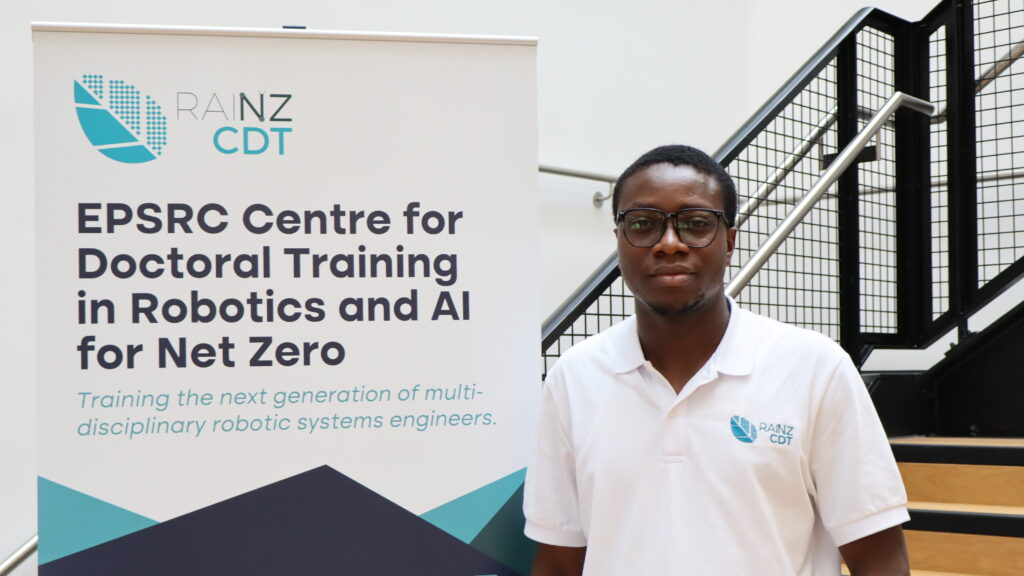
Current postgraduate researcher Ibrahim Aromoye reflects after his first year on the Robotics and AI for Net Zero (RAINZ) Centre for Doctoral Training, from building green robots to preparing for his PhD research in Human-AI collaboration.
Sustainable robotics and AI for net zero
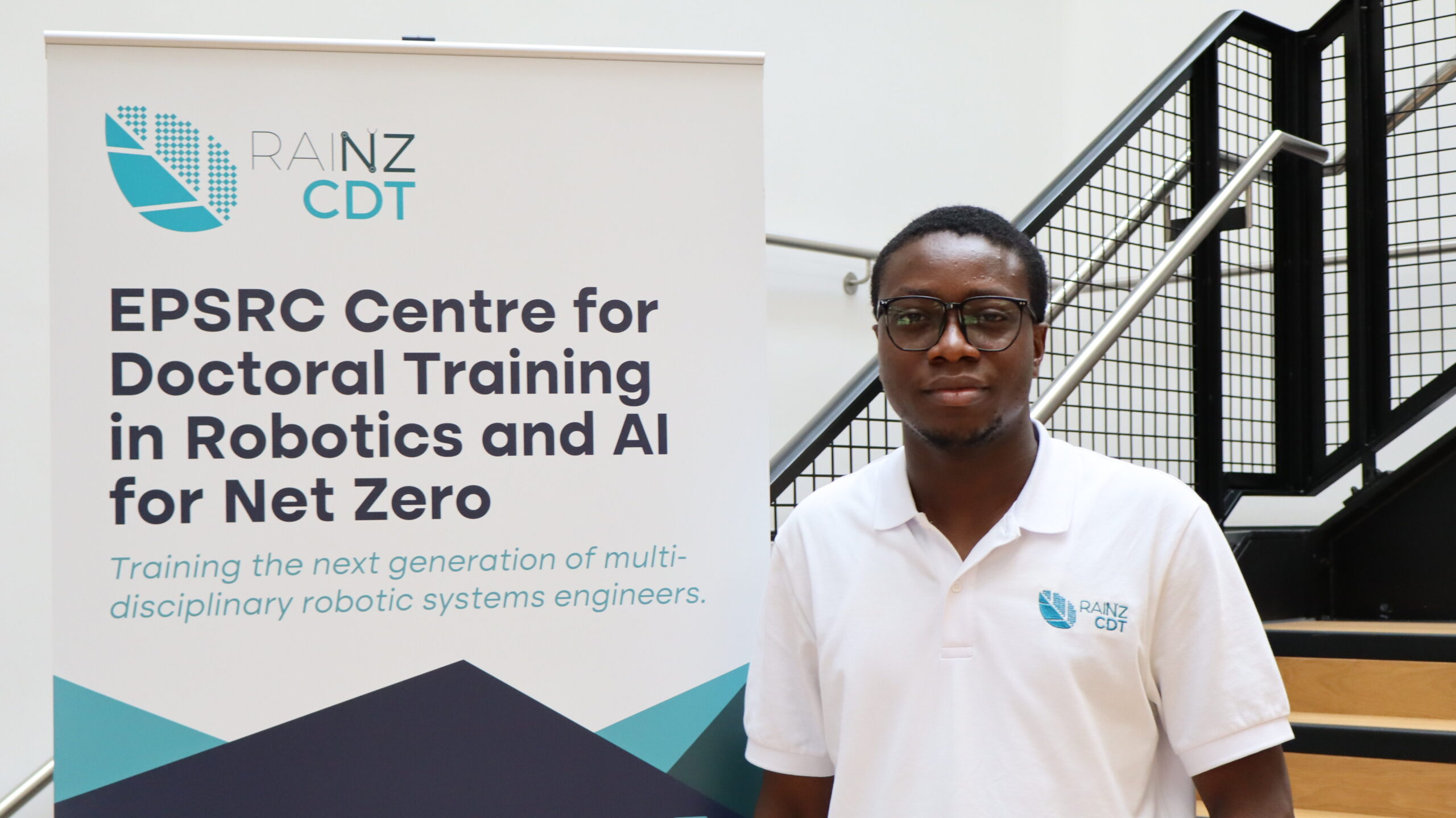
The RAINZ CDT focuses on sustainable robotics, and the role robotics and AI can play in supporting net zero. For Ibrahim, that means thinking carefully about how robots are designed, built, used and reused. He is aware that building robots can have an environmental impact, so reducing carbon at every stage matters. That includes reusing and recycling parts, lowering the carbon involved in design and build, and writing “green” software. As Ibrahim explains, “This means you only write the lines of code that are necessary for the robot to function.”
Sustainability is not something Ibrahim sees as separate from robotics. It is something he factors into everything he does. After his bachelor’s degree in Computer Engineering, he worked for two years in Nigeria and became more aware of the UN Sustainable Development Goals (SDG). “I started to become conscious of whatever was being built – you have to look at it from the view of SDG, you have to be conscious of that,” he says, and this awareness grew during his master’s in electronic engineering in Malaysia. “During my master’s, I thought, this is not even debatable. It’s one of the things you must factor in.”
But for Ibrahim it all started with a focus on energy saving; having completed his final year project during his bachelor’s degree on electricity saving, and even as a child, he remembers going around switching off lights to save energy. “I’ve always been conscious of energy saving, power saving, unconsciously knowing there was a need for that,” he says. “Back then, I didn’t really have much knowledge about SDG, I was just doing it to save money, but during my master’s, I came to realise that everything you’re doing has to follow some sort of SDG goal.”
Building confidence through robotics training
Moving to the UK brought new experiences, from adjusting to a different culture to getting used to the weather after living in the hot climates of Nigeria and Malaysia. Ibrahim reflects, “it could be daunting moving from one place to another”, but he has approached the move as part of the experience.
Having completed two semesters of taught modules from the MSc in Robotics programme during his first year on the RAINZ programme here at The University of Manchester, Ibrahim says he has gained valuable robotics experience after coming from a background in computer engineering and electrical/electronics engineering.
“When I signed up for the PhD, I knew there would be challenges – I have the engineering background, but it’s good to have a taste of robotics before actually going for that PhD.” Because robotics is a multidisciplinary field, the training he has received during this first year has helped him build confidence and technical know-how across areas he had not studied in depth before.
Hands-on robotics training and cohort support
“[The CDT] has a lot of training embedded in it beyond just getting the PhD,” Ibrahim says. His cohort has received technical and non-technical training, including training in EDI, mental health and ethical AI.
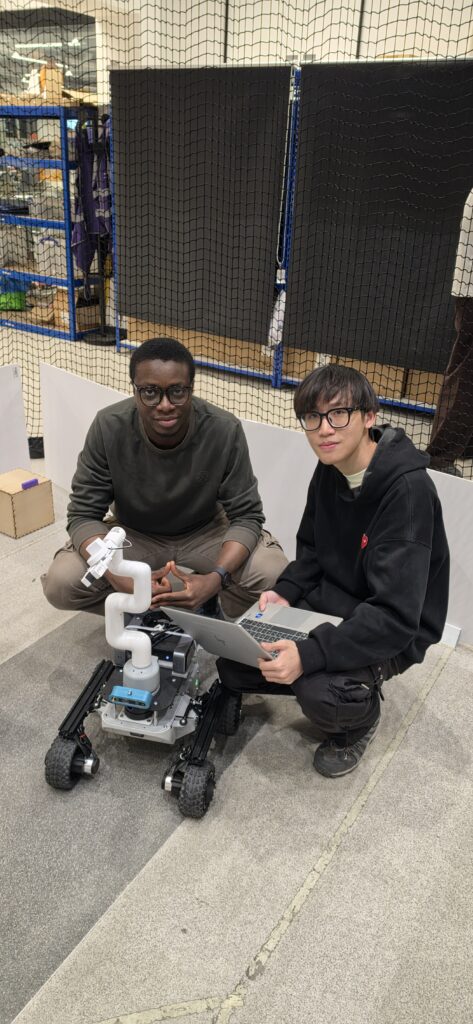
He has particularly enjoyed the hands-on experience and working with actual robots, not just simulations. “So far, every one of our courses, they have corresponding lab work to support your learning, so it’s not just about theory. You get to go into an actual lab, to implement what you think.”
A robotics systems project also gave him a real-world taste of collaborative research. Stakeholders acted as clients, proposing a problem that needed a solution. Ibrahim and researchers from different subject areas worked together to respond to the brief, giving him confidence that he could build a future career in robotics.
For Ibrahim, one of the biggest benefits of the CDT is the cohort. “If you look at the conventional PhD, it’s only you and most likely your supervisory team, you don’t have any other person to look at your problem from a different perspective or other different viewpoint.”
Regular touchpoints with his cohort have helped him feel supported, from weekly in-person meetings to a WhatsApp group and multiple group sessions during the summer school here in Manchester.
“It’s one of the good things about this cohort-based manner, you’re building that network.” He also benefits from a wider network of academics within and beyond the CDT, including a mentor from an EU Doctoral Network at the University of Bristol. Soon, he will become a mentor himself for someone in the next cohort: “We’re looking forward to being a mentor to the second cohort, so they’re trying to build that network as well.”
PhD research in Human-AI collaboration and nuclear robotics
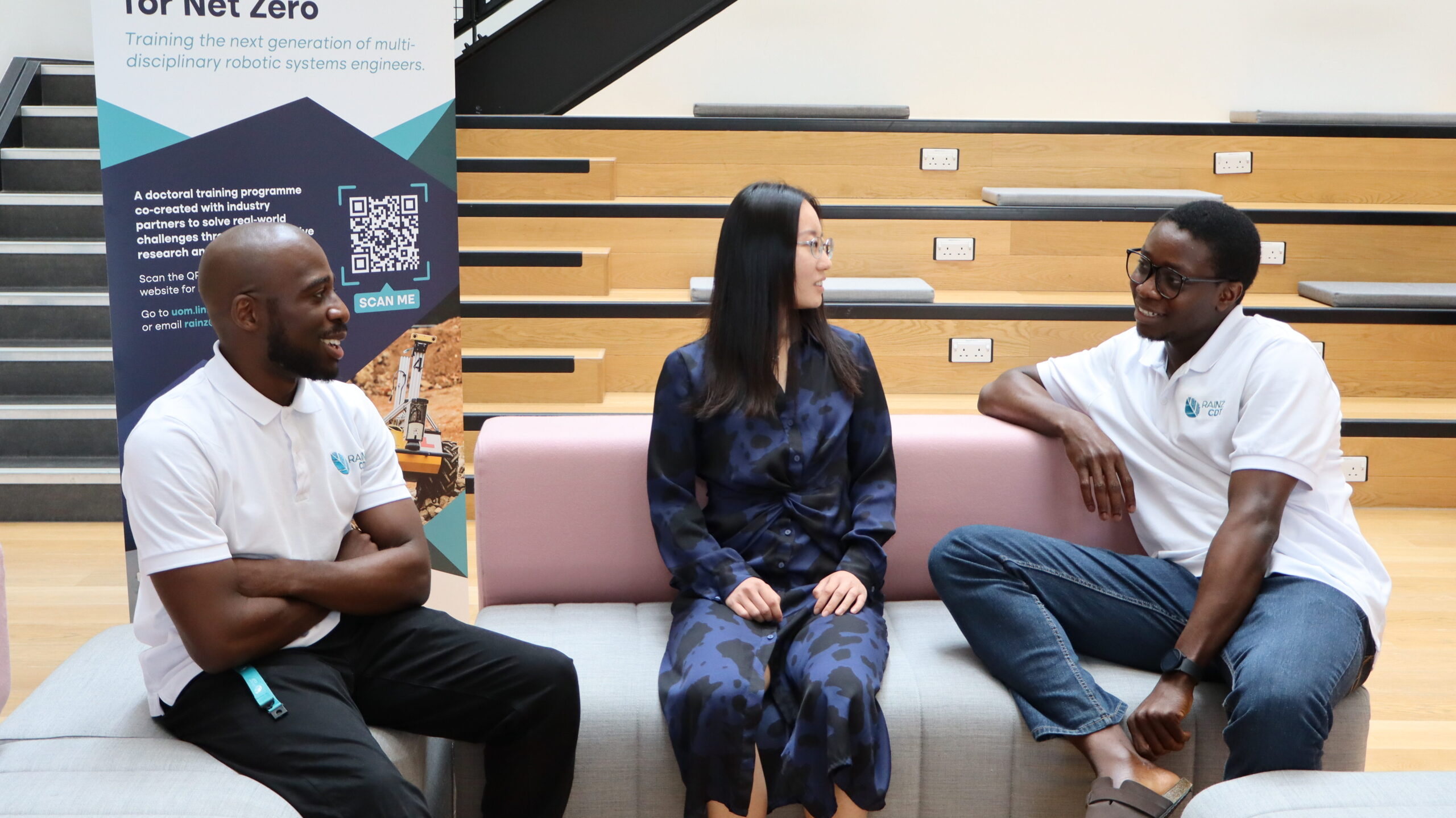
Ibrahim is now moving to the University of Glasgow to begin the research component of his PhD, where his research will focus on Human-AI collaboration and remote teleoperation within nuclear facilities. His project is sponsored by the UK Atomic Energy Authority (UKAEA).
He is interested in creating “a space where humans and robots work together where the robots could trust the human and the human could trust the robot”, with “some sort of a shared autonomy”.
In hazardous environments such as nuclear facilities, robotics can help keep human operators safe. But when an operator has to control a robot remotely, the process can create a lot of mental strain.
“I will be looking at building a safe system where the robot could do the picking and handling of those delicate objects itself, where we have reduced cognitive overload for humans,” Ibrahim explains. “That way humans could focus on more higher-level thinking, rather than being stressed over picking up an object.”
Advice for future PhD students in robotics and AI
Ibrahim’s dream is to become an expert in robotics, either by starting his own robotics company or working as a consultant. He also wants to give back to communities in Nigeria and the UK.
“I will definitely want to give back to the UK community because we are publicly funded, so we have a mission to give back to the community,” he says. “It’s continuous that way.”
“Be audacious,” is Ibrahim’s advice to future PhD students. “You have nothing to lose.” He explains that he took a chance applying to the RAINZ programme as an international student, as it was mainly for home students.
He says he would not be where he is today if he had not taken that step.
“The staircase leads somewhere; it doesn’t end midway. Of course, you don’t have the full picture, but for every step you take it becomes clearer, so just keep going.”
Ibrahim Aromoye, RAINZ CDT postgraduate researcher
Ibrahim’s first year on the RAINZ programme has given him the confidence, skills and connections he needs for his PhD research. With his supervisory team at Glasgow already helping him shape the next stage, he is ready to embrace his research journey, his work in robotics and AI, and the weather in Scotland.
Learn more about PhD opportunities in robotics and AI
If you are interested in robotics, AI, sustainability or research that supports net zero, explore PhD opportunities through the RAINZ CDT and discover how you could help shape the future of sustainable robotics.
Last reviewed: